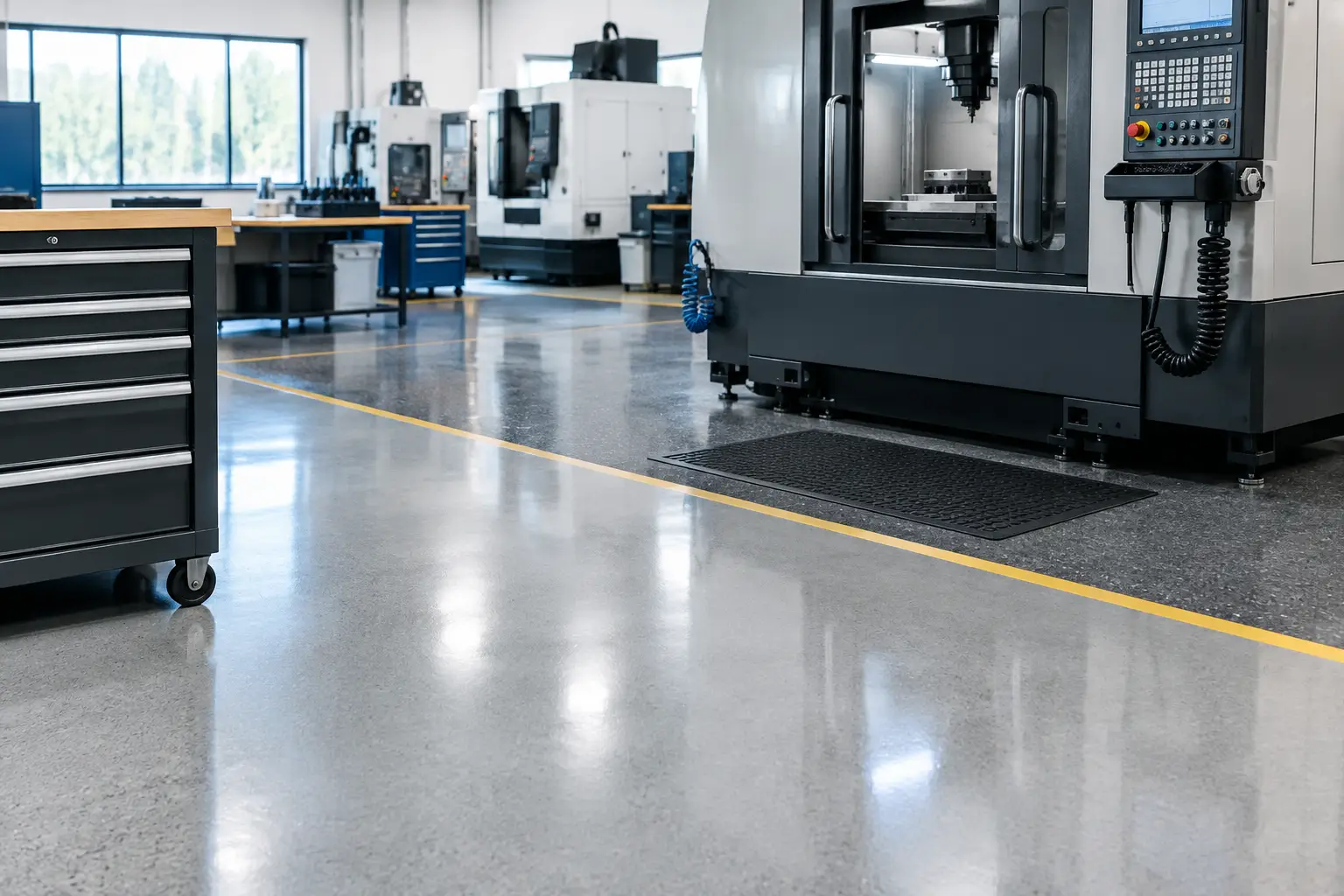

In a modern logistics environment, a Very Narrow Aisle (VNA) operation looks flawless on paper: maximized storage density, high-speed throughput, and automated precision. However, many operators discover that these efficiencies are often lost the moment the wheels hit the concrete.
When turret trucks, wire-guided systems, and tight rack tolerances depend on predictable travel, small slab defects stop being cosmetic issues. In this environment, VNA floors are not just a building component; they are part of the operating system. If the floor is wrong, the equipment cannot perform as intended, and the facility’s ROI begins to erode through maintenance costs and lost productivity.
Why VNA Floors Demand a Higher Standard
Standard industrial slabs are not designed for the extreme demands of VNA traffic. In a conventional warehouse, broader aisles and varied lift truck movements can absorb minor floor variations. In a VNA environment, the dynamics change entirely.
- Fixed Wheel Paths: Unlike open-plan warehouses where traffic is distributed, VNA trucks travel over the exact same wheel paths thousands of times. This concentrates all wear and stress on a few square centimeters of concrete.
- Lift Heights and Leverage: As warehouse heights increase (often exceeding 15-18 meters), even a 1mm deviation at the floor level can translate into a massive sway at the top of the mast. This "static lean" and "dynamic lean" can cause trucks to strike racking or slow down to a crawl to avoid vibration.
- Guidance Reliability: Wire-guided systems require a stable platform to maintain signal integrity and steering accuracy.
At Osis Group, we emphasize that superflat construction (meeting standards like FM1 or FM2 per TR34) is not a premium luxury—it is a functional requirement.
Critical Factors for VNA Floor Performance
1. Superflat Tolerances in the Wheel Paths
Floor quality cannot be judged by a visual walkthrough. In VNA applications, performance is defined by Property II (flatness) and Property III (levelness) across the transverse and longitudinal dimensions of the aisle.
Localized highs and lows, or "edge curl" near joints, create mast instability. This forces operators to reduce speed, significantly impacting "picks per hour." Our use of Laser Screed technology and specialized finishing techniques ensures those tolerances are met during the initial pour, or corrected through precision grinding.
2. Joint Strategy and Long-term Behavior
Joints are the Achilles' heel of any industrial floor. Even if a slab is perfectly flat on day one, poor joint design can lead to:
- Spalling: Breaking of joint edges under hard-polyurethane truck wheels.
- Differential Movement: One slab sinking lower than its neighbor under load.
- Curling: The corners of the slabs lifting as the concrete dries.
For VNA environments, Osis Group often recommends armoured joints or jointless floor designs (large-area pours with steel fiber reinforcement) to minimize the number of "impact points" a truck encounters.
3. Surface Finish and Wear Resistance
A VNA floor must hold its profile for years. If the surface is weak or poorly cured, it will "dust" or "rut," creating microscopic debris that destroys truck bearings and guidance sensors. High-shake toppings and liquid densifiers are essential to ensure the surface remains "superflat" despite constant friction.
New Construction vs. Retrofitting Existing Facilities
In New Construction:
The goal is "Right First Time." This requires early coordination between the flooring contractor, the racking provider, and the MHE (Material Handling Equipment) supplier. By aligning the slab design with TR34 (4th Edition) or ACI 360 standards from the start, we ensure the building is ready for VNA equipment the moment the concrete cures.
In Existing Facilities:
Many warehouses "upgrade" to VNA to increase capacity. In these cases, the existing slab rarely meets the required tolerances. Osis Group specializes in VNA Floor Correction, which involves:
- Precision Grinding: Using automated robotic grinders to create perfectly level tracks within the aisles.
- Joint Stabilization: Injecting resins or installing mechanical floor stabilizers to stop slab rocking.
- Wire Guidance Installation: Cutting clean, precise slots for guidance wires that won't compromise the structural integrity of the floor.
The Role of Wire Guidance
Wire guidance keeps VNA operations precise, but it is not a cure for a bad floor. If the slab has inconsistent wheel paths or failing joints, the guidance system will constantly fight to correct the truck’s path, leading to increased wear on steering motors. A clean, professional installation—where wires are properly embedded and protected—is essential for long-term system reliability.
Common Failure Points to Watch For
Most VNA floor issues manifest as "operational friction":
- Reduced Travel Speed: Trucks automatically slow down due to vibration sensors.
- Higher Maintenance Costs: Frequent replacement of expensive polyurethane wheels.
- Operator Fatigue: Constant vibration and "sway" make high-level picking stressful and slow.
- Rack Damage: Masts coming too close to rack uprights due to floor lean.
Choosing the Right Partner
The technical complexity of VNA floors means they cannot be treated as generic concrete work. When choosing a contractor, decision-makers should ask:
- Can they demonstrate compliance with TR34 (FM1/FM2) or DIN 18202?
- Do they have experience in VNA-specific grinding and joint repair?
- Can they work within an occupied facility without shutting down the entire operation?
At Osis Group, we bring years of experience in Qatar, the UAE, Greece, and KSA to every project. We understand that in a VNA warehouse, the floor is the foundation of your profitability. By focusing on precision, workmanship, and long-term durability, we ensure your facility operates at its theoretical maximum efficiency.
Contact Osis Group today to discuss your next VNA flooring project or to request a floor survey for your existing facility.